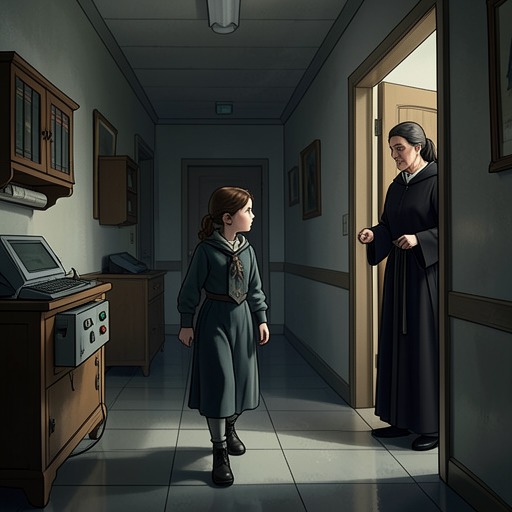
Delvina
The StaircaseDelvina is a young woman hiding from her violent husband near Fort Marcy, first introduced through Violate Lacey’s acts of clandestine care. She gives birth in an abandoned building, survives long enough to entrust her newborn and a twenty-dollar gold piece to others, and then dies at the convent. Her brief life in the novel is shaped by the difference between being hidden and being safe: food and blankets reach her in isolation, but protection arrives only after childbirth has left her gravely weak. Her death makes the baby’s future a question for the convent, while the coin she leaves behind binds her story to the uncertain identity and criminal history of her husband.
Identity and Circumstances
Delvina lives at the fort, where Violate visits her with food and extra blankets. Violate calls her a friend and describes her as expecting a baby, but Delvina’s refuge is precarious: she has a husband who strikes her, and she is afraid he will kill both her and the child. She cannot safely return home. Her existence at the fort is therefore not a chosen retreat from the town so much as a concealment forced on her by violence.
The danger around her is not merely personal. When Lizzy later finds her, Delvina is sheltering in a crumbling, two-story building with holes in its walls. The openings offer a view but also admit the cold. Delvina lies on dusty blankets with her newborn, exposed to the weather and without the dependable care that childbirth requires. The setting gives material form to the limits of her refuge: she has escaped her husband’s immediate reach, but the place where she hides cannot keep her or her baby warm or secure.
Birth and Rescue
The rescue begins when Lizzy and Violate hear a baby crying as they cross the mesa. Following the sound to the building, they find Delvina with her newborn. Delvina has given birth the previous night. She explains that she was not entirely alone: Lozen stayed with her, fetched water, and made a fire. The charred remains nearby corroborate her account of that night’s practical help. Lozen has left by the time Lizzy and Violate arrive, so the women find Delvina and the child in the vulnerable aftermath of birth rather than during the labor itself.
Lizzy brings blankets and tells Delvina that Sister Roberta wants her to come to the convent, where there is a place for her. Delvina hesitates because she fears it will not be safe. Violate insists that it is safer than the building, and Lizzy is tasked with riding back for a wagon. Delvina then admits that she is not as strong as she had thought and does not feel well. Her hope is reduced to the possibility that the nuns will find a place for her baby. The exchange turns a search for shelter into an urgent effort to move both mother and child before Delvina’s condition worsens.
Death and the Child’s Future
By the time Lizzy returns to the school, Ramona tells her that Delvina has died. The news strikes Lizzy hard, though she had known Delvina was unwell. At the convent, the death is marked by candles, covered mirrors, prayers, winding sheets, and the tolling church bell. Sister Roberta tells Lizzy that she was with Delvina and describes her death as peaceful. Lizzy cannot accept the idea that death is peaceful, setting her own response to loss against the convent’s language of a happy death.
The rules governing burial make the decision about Delvina’s body immediate. Mother Magdalena explains that Santa Fe requires bodies to be buried within twenty-four hours; because the next day is Sunday, the funeral will take place that evening. The convent will keep the baby, at the bishop’s wish. Mother Magdalena says there appear to be no relatives except a drunken, violent father. Delvina’s death thus ends the possibility of her caring for her child, while the convent’s decision gives the newborn a place to remain. The account does not establish what becomes of the child after this decision, but it makes clear that the baby’s immediate safety depends on others taking responsibility.
The Coin and Ramon Baca
Before she dies, Delvina gives Violate a twenty-dollar gold piece and asks her to pass it to Lizzy. The gift carries an unsettling uncertainty. Violate had earlier told Lizzy that Jesse James gave Delvina such a coin, a story Lizzy had dismissed as another of Violate’s implausible claims. When Lizzy receives the coin, she recognizes it as the same one. She wonders whether it really came from Jesse James, then considers another possibility: Delvina’s husband was a thief, and the money may have been part of an illegal bounty. The coin is therefore both a personal bequest and an object whose origin remains in doubt.
The husband’s identity sharpens the danger without resolving the coin’s history. A newspaper identifies him as Ramon Baca, long suspected of murdering government official James L. Collins and stealing one hundred thousand dollars in government funds in 1869. The report says Ramon has disappeared, remains at large, and is dangerous. The news also brings the threat close to the convent: the girls hear that he may come to demand the baby. Elinora says her uncle, the bishop, will not give the child to him. Delvina’s fear that her husband could harm her and the baby is thus extended beyond her death; the child remains exposed to a man described as violent and wanted for grave crimes. Lizzy’s discovery of Ramon’s identity also makes the earlier Jesse James story harder to accept as fact, but the novel does not confirm who actually gave Delvina the coin.
Narrative Significance
Delvina appears through other people’s care and testimony: Violate brings provisions, Lozen assists at the birth, Lizzy helps bring her and the baby toward shelter, and the convent assumes custody after her death. These acts offer real aid, yet they cannot undo the violence and bodily danger that define Delvina’s circumstances. Her own account is brief but decisive: she names Lozen’s help, acknowledges her weakness, and worries about where her baby will live. The story does not give her a recovery or a future beyond those moments.
Her death also brings together several strands of the narrative: Lizzy’s growing involvement in Violate’s life, the convent’s responsibility for an endangered infant, and the mystery surrounding the gold coin and Ramon Baca. The coin passes from Delvina to Lizzy after Delvina can no longer explain its origin, so it preserves a connection while withholding certainty. Delvina’s fate is not presented as a solved mystery or a dramatic escape; it is the consequence of a life made unsafe, followed by a contested effort to protect the child she leaves behind.